
Giải chi tiết đề thi thật IELTS Writing 2024 – Từ Band 6.0 đến 8.5
Task 1:
Band 6.0-6.5
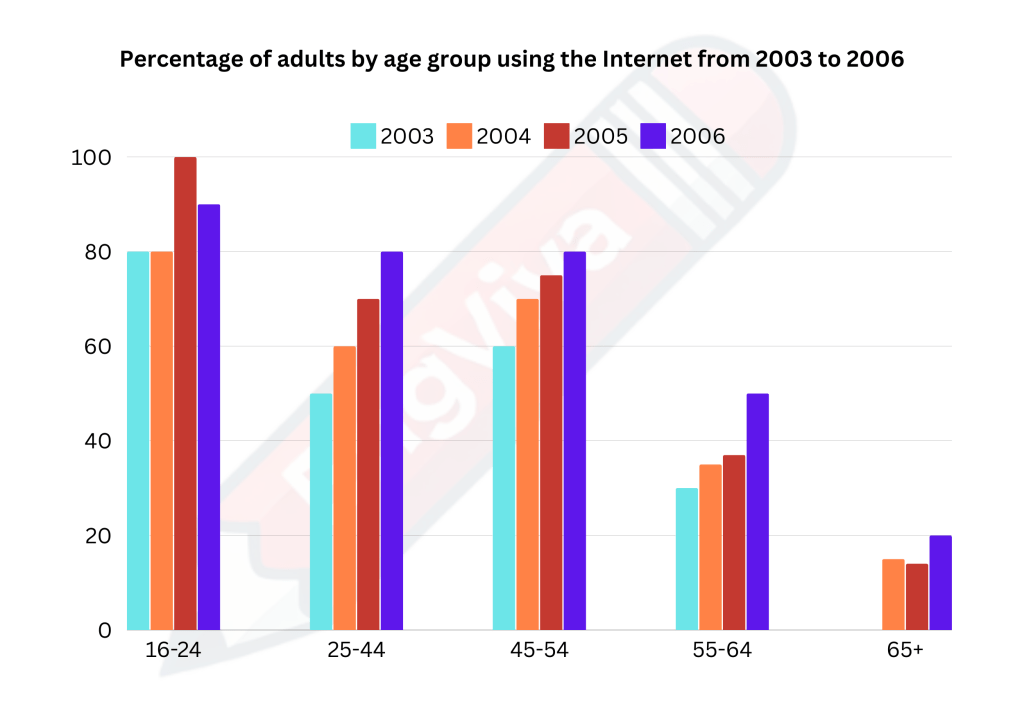
The bar chart illustrates the percentage of adults in different age groups using the Internet from 2003 to 2006. The age groups presented are 16-24, 25-44, 45-54, 55-64, and 65+.
Overall, younger adults aged 16-24 consistently had the highest percentage of Internet use across all years, while the 65+ age group had the lowest. In 2003, 80% of 16-24-year-olds used the Internet, and this rose to almost 100% in 2006. The percentage for the 25-44 group also increased, from around 50% in 2003 to about 80% by 2006.
For the 45-54 age group, Internet use went from approximately 60% in 2003 to over 90% in 2006. Similarly, those aged 55-64 saw growth in Internet usage, from around 30% in 2003 to almost 60% by 2006. In contrast, the 65+ group had minimal change, starting at about 10% in 2003 and reaching just above 20% in 2006.
In summary, the trend shows that Internet usage increased across all age groups from 2003 to 2006, with younger age groups always maintaining a higher percentage.
Band 7.0-7.5
The bar chart compares the percentage of adults in various age groups who used the Internet between 2003 and 2006. The groups examined range from 16-24 to 65+.
Overall, it is evident that younger adults had the highest levels of Internet use throughout the period, with older adults trailing behind. The 16-24 age group began with 80% Internet use in 2003, which steadily climbed to just under 100% by 2006. Meanwhile, the 25-44 group experienced a significant increase from around 50% in 2003 to almost 85% in 2006.
In contrast, Internet use for the 45-54 age group started at approximately 60% in 2003 and surged to over 90% by 2006. The 55-64 group followed a similar pattern, growing from just below 40% to around 60% over the four years. Finally, the 65+ group had the lowest figures, beginning at 10% in 2003 and only reaching slightly above 20% in 2006.
In conclusion, Internet usage increased across all age categories, with the younger population showing consistently higher engagement than older groups.
Band 8.0-8.5
The bar chart illustrates how the percentage of Internet users across five distinct age groups in a European country evolved from 2003 to 2006.
It is clear from the data that Internet usage was far more prevalent among younger individuals than older ones throughout the given period. The 16-24 age group demonstrated the highest Internet penetration, starting at 80% in 2003 and rising to nearly 100% by 2006. The 25-44 demographic also saw substantial growth, from just under 50% in 2003 to around 85% by 2006.
The 45-54 group experienced steady increases, with usage growing from approximately 60% in 2003 to over 90% by 2006. Meanwhile, the 55-64 age bracket started at just under 40% in 2003 but managed to reach nearly 60% by 2006. Notably, the 65+ group lagged far behind all other groups, with Internet usage figures ranging from just above 10% in 2003 to slightly above 20% in 2006.
In conclusion, the chart demonstrates a clear upward trend in Internet usage across all age groups, with younger individuals consistently showing higher rates of Internet adoption compared to older demographics.
Breakdown of Differences:
- Band 6.0-6.5
- Basic description of trends with some simple comparisons.
- Uses less complex sentence structures and vocabulary.
- More straightforward and less analytical.
- Band 7.0-7.5
- Provides more detailed comparisons, including specific figures.
- Some higher-level vocabulary and more variety in sentence structures.
- Clearly describes differences between groups.
- Band 8.0-8.5
- More sophisticated and precise language.
- Describes patterns and trends with clear insight.
- Uses complex sentence structures and advanced vocabulary to articulate the data trends.
Discover more from Viva English Academy
Subscribe to get the latest posts sent to your email.
 Viva English Academy