
Giải chi tiết đề thi thật IELTS Writing 2024 – Từ Band 6.0 đến 8.5
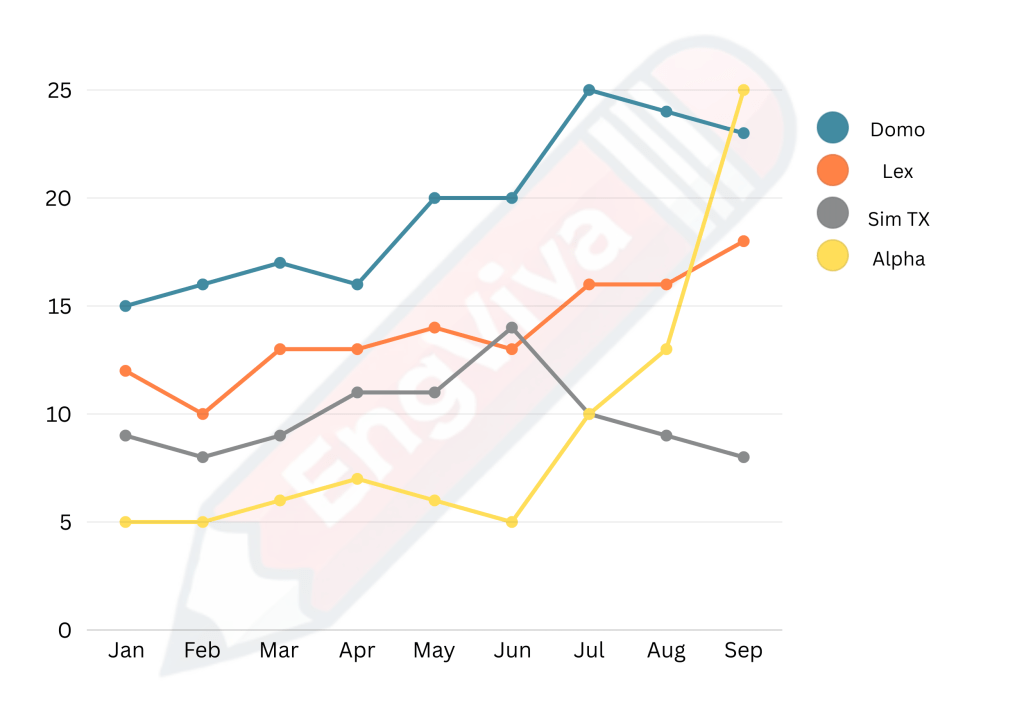
Task 1: The chart below shows the average cost of monthly contract for four different mobile (cell phones) in a European country from January to September 2002, measured in euro.
IELTS Task 1 Writing – Version 1 (Band 6.0-6.5)
The line graph illustrates the monthly contract costs for four mobile phone services, Domo, Lex, Sim TX, and Alpha, in a European country between January and September 2002, measured in euros.
Overall, the cost of Domo and Lex generally increased throughout the period, while Sim TX and Alpha fluctuated. Domo consistently had the highest monthly charges, whereas Alpha remained the cheapest service.
At the beginning of the period, Domo’s cost was around 15 euros, which remained steady until May before increasing sharply to around 22 euros in August. Lex started at approximately 12 euros in January, experiencing some fluctuations before rising to nearly 18 euros by September.
Sim TX began at about 10 euros, reaching a peak in May but then dropping steadily to around 8 euros by September. Alpha, starting as the cheapest option at 5 euros in January, showed minor fluctuations and then rose sharply in August to finish at just under 10 euros.
In conclusion, Domo became the most expensive option over time, while Alpha remained the cheapest, but with an upward trend towards the end.
(173 words)
IELTS Task 1 Writing – Version 2 (Band 7.0-7.5)
The line graph compares the average monthly contract costs of four mobile phone providers—Domo, Lex, Sim TX, and Alpha—in a European country from January to September 2002, measured in euros.
Overall, it is clear that Domo and Lex experienced upward trends in their monthly costs, while Sim TX and Alpha showed more fluctuation, with Sim TX seeing a notable decline towards the end of the period. Domo consistently charged the highest, whereas Alpha remained the lowest-cost option throughout.
In January, Domo started at around 15 euros and remained relatively stable until May. After this, its cost saw a significant increase, peaking at over 22 euros in August before slightly declining to around 21 euros in September. Lex followed a similar pattern, rising from approximately 12 euros in January to 18 euros by the end of the period.
Sim TX, which began at 10 euros, showed a brief increase in April before steadily declining to just over 8 euros in September. Alpha started at 5 euros, remained stable for the first half of the year, and then saw a sharp rise in August to around 10 euros.
In summary, Domo and Lex saw a steady rise in costs, while Sim TX and Alpha remained more volatile.
(188 words)
IELTS Task 1 Writing – Version 3 (Band 8.0-8.5)
The line graph illustrates the fluctuations in the average monthly contract costs of four mobile service providers—Domo, Lex, Sim TX, and Alpha—in a European country from January to September 2002, measured in euros.
Overall, the data reveals that Domo and Lex followed upward trajectories, while Sim TX experienced a downward trend after an initial rise. Alpha, though the cheapest option for most of the period, also saw a notable increase towards the end. Domo consistently remained the most expensive service.
In January, Domo began with an average cost of approximately 15 euros. This figure remained relatively constant until May, after which it increased dramatically, reaching a peak of around 22 euros in August before leveling off slightly in September. Similarly, Lex started at around 12 euros and, despite some fluctuations, rose steadily to finish at just under 18 euros.
Sim TX, on the other hand, started at 10 euros and saw a modest rise until April, peaking at just over 12 euros, before declining sharply to 8 euros by September. Alpha maintained its position as the lowest-cost provider, starting at 5 euros, but surged to almost 10 euros in August before stabilizing.
In conclusion, Domo and Lex consistently became more expensive over time, while Sim TX and Alpha displayed more volatility, with Alpha showing a significant price rise in the later months.
(197 words)
Here’s a detailed breakdown of the key differences between the three versions (Band 6.0-6.5, Band 7.0-7.5, and Band 8.0-8.5) of the IELTS Task 1 writing task, focusing on the structure, vocabulary, and sentence complexity that contribute to the different band scores:
1. Band 6.0-6.5:
- Sentence Structure: Sentences are relatively simple, with basic structures and limited complexity. The focus is on describing what is shown in the graph without much variation in sentence types.
- Vocabulary: Uses basic vocabulary and repetitive phrases such as “increase,” “decrease,” and “fluctuate.” The writer does not employ much variety in word choice.
- Comparison and Analysis: The essay primarily reports data without much in-depth comparison between the figures. The analysis lacks insight into trends or patterns beyond basic observations.
- Linking Devices: Limited use of cohesive devices such as “overall,” “in conclusion,” “while,” and “whereas.” The transitions are simple and functional, rather than complex.
- Example:“At the beginning of the period, Domo’s cost was around 15 euros, which remained steady until May before increasing sharply to around 22 euros in August.”
- Here, the sentence is clear but basic, reporting information without deeper analysis of trends.
2. Band 7.0-7.5:
- Sentence Structure: More varied and complex sentence structures, including compound and complex sentences. The writer shows greater flexibility in sentence types.
- Vocabulary: The vocabulary is broader, incorporating some more advanced words such as “trajectory,” “stable,” “sharp rise,” “decline steadily.” The essay avoids repetitive language and adds more descriptive terms.
- Comparison and Analysis: The comparisons between data points are clearer and more insightful. The writer begins to explore patterns and relationships in the data rather than simply reporting the figures.
- Linking Devices: More frequent and varied use of cohesive devices, making the essay flow better. Words such as “similarly,” “despite,” and “in contrast” are used to enhance coherence.
- Example:“Domo started at around 15 euros and remained stable until May before rising sharply to over 22 euros in August.”
- The use of “remained stable” and “rising sharply” shows a more detailed and precise way of describing the changes.
3. Band 8.0-8.5:
- Sentence Structure: There is significant variety in sentence types, with the use of complex, compound-complex, and conditional structures. The essay demonstrates mastery of more sophisticated sentence patterns.
- Vocabulary: The vocabulary is advanced, using more precise and less common terms like “upward trajectory,” “leveling off,” “dramatic increase,” and “volatile.” The writer shows a strong command of a range of words, with minimal repetition.
- Comparison and Analysis: The analysis is deep, providing nuanced insight into trends, such as the nature of the changes (e.g., whether the increase is sharp, steady, or gradual). The essay does not just describe what happens but also evaluates the data’s significance in a more analytical way.
- Linking Devices: The use of cohesive devices is excellent, with phrases like “in contrast,” “while,” “despite,” and “whereas” adding complexity and clarity to the essay. The transitions between points are seamless.
- Example:“Domo began with an average cost of approximately 15 euros. This figure remained relatively constant until May, after which it increased dramatically, reaching a peak of around 22 euros in August before leveling off slightly in September.”
- The use of “increased dramatically” and “leveling off slightly” demonstrates the ability to analyze and describe changes in a sophisticated manner.
Summary of Differences:
- Sentence Structure:
- Band 6.0-6.5: Mostly simple and compound sentences.
- Band 7.0-7.5: More varied sentence structures, including complex sentences.
- Band 8.0-8.5: Wide variety of sentence structures, with advanced patterns like conditional and compound-complex sentences.
- Vocabulary:
- Band 6.0-6.5: Basic vocabulary, with some repetition.
- Band 7.0-7.5: More advanced vocabulary and descriptive terms, less repetition.
- Band 8.0-8.5: Advanced vocabulary, precise and nuanced descriptions, minimal repetition.
- Analysis and Comparison:
- Band 6.0-6.5: Basic reporting of facts without much analysis or insight.
- Band 7.0-7.5: More detailed comparisons, with some analysis of trends.
- Band 8.0-8.5: In-depth analysis and nuanced insight into trends and data.
- Linking Devices:
- Band 6.0-6.5: Basic linking words, limited variety.
- Band 7.0-7.5: More frequent and varied linking devices.
- Band 8.0-8.5: Excellent use of cohesive devices to enhance coherence.
The differences across the levels come down to complexity, vocabulary sophistication, and depth of analysis. The higher the band score, the more intricate the sentence structures, the broader the vocabulary, and the deeper the insights into the data.
Discover more from Viva English Academy
Subscribe to get the latest posts sent to your email.
 Viva English Academy