
Giải chi tiết đề thi thật IELTS Writing 2024 – Từ Band 6.0 đến 8.5
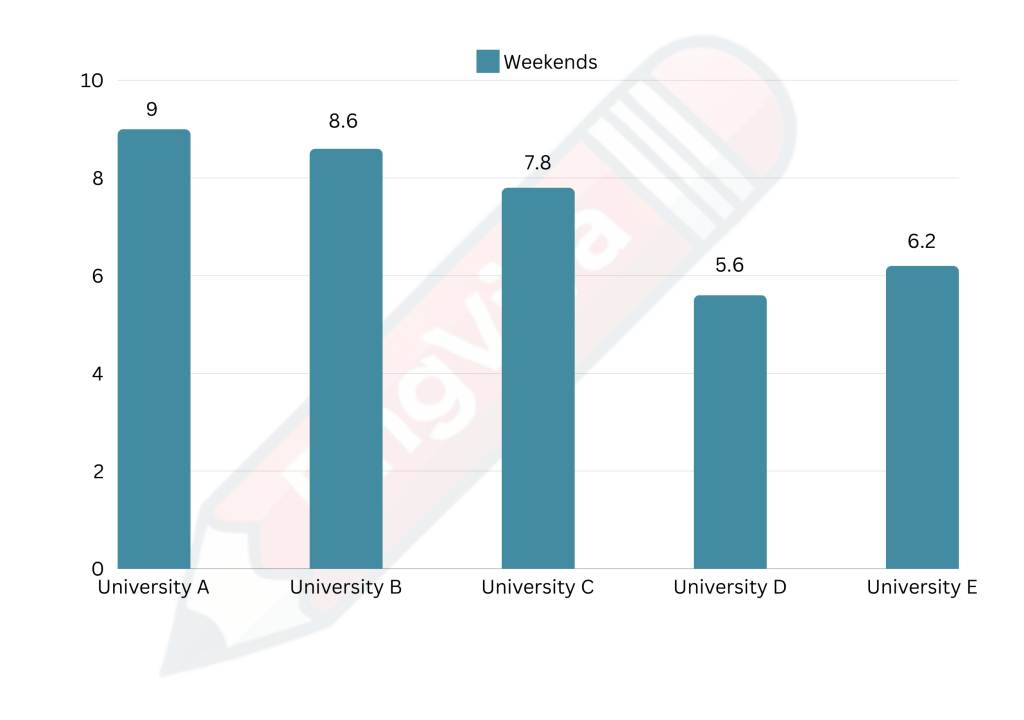
TASK :1 The bar chart shows the average number of hours students in five different universities studied.

Band 6.0-6.5 Version:
The bar chart compares the average number of hours students from five universities (A, B, C, D, and E) studied on weekdays and weekends.
On weekdays, University C students studied the most with 10.6 hours, followed by students from University B and E who spent 10.1 and 10 hours respectively. University A students spent an average of 9.8 hours studying, and students at University D spent the least time with 9.6 hours.
During the weekends, the hours of study decreased for all universities. University A had the highest number of study hours at 9, while students from University B and C studied 8.6 and 7.8 hours. University D had the lowest number of study hours on weekends with only 5.6 hours, followed by University E with 6.2 hours.
Overall, students from all five universities studied more during the weekdays than on weekends, with University C having the highest hours on weekdays and University A having the highest on weekends.
Band 7.0-7.5 Version:
The bar chart illustrates the average number of study hours for students from five different universities (A, B, C, D, and E) on weekdays and weekends.
During weekdays, students at University C put in the most hours, averaging 10.6 hours per day, while students from Universities B and E followed closely, with 10.1 and 10 hours, respectively. University A students studied slightly less, with 9.8 hours, while University D had the fewest study hours, at 9.6.
On weekends, all universities saw a decline in the number of hours studied. University A had the most hours, with 9, followed by University B at 8.6 and University C at 7.8. Meanwhile, University D recorded the lowest number of hours studied on weekends, with 5.6 hours, while students from University E studied 6.2 hours.
In summary, students across all universities tended to study more during weekdays than on weekends, with University C leading on weekdays and University A leading on weekends.
Band 8.0-8.5 Version:
The bar chart provides a comparison of the average number of hours students from five universities (A, B, C, D, and E) spent studying on both weekdays and weekends.
On weekdays, University C students dedicated the most time to their studies, averaging 10.6 hours per day, followed by University B at 10.1 hours and University E at 10 hours. University A students studied for an average of 9.8 hours, and University D had the lowest study hours, at 9.6.
A significant reduction in study hours was observed across all universities on weekends. University A students remained the most studious, averaging 9 hours, while University B students recorded 8.6 hours, and University C averaged 7.8 hours. University D students studied the least, with just 5.6 hours, while University E students averaged 6.2 hours.
Overall, the chart indicates that students generally spent more time studying on weekdays compared to weekends, with University C leading on weekdays and University A on weekends.
Breakdown of Differences Between Band Levels
Band 6.0-6.5 Version:
- Structure: The structure is simple and straightforward, without much complexity in sentence patterns. The student simply describes the information in the chart, sticking to basic sentence forms. There’s no deeper analysis or variation in expression.
- Vocabulary: The vocabulary used is basic and repetitive (e.g., “students studied the most,” “spent an average,” “had the least”). There’s little use of advanced or varied vocabulary.
- Cohesion and Coherence: The use of cohesive devices (linking words like “followed by,” “while,” “and”) is minimal and mainly focused on simple comparisons. The flow of ideas is clear but basic.
- Grammar: Basic grammatical structures are used correctly (e.g., simple past tense, comparative forms), but there’s little attempt to vary sentence types. Errors are minimal but the range of grammar used is narrow.
This version is designed for someone who can convey basic information clearly but without much complexity in language use.
Band 7.0-7.5 Version:
- Structure: This version shows a more structured approach to the task. Sentences are varied with the introduction of more complex structures, such as dependent clauses (e.g., “During weekdays, students at University C put in the most hours, averaging 10.6 hours per day…”).
- Vocabulary: There’s more variety in vocabulary compared to the 6.0-6.5 version. Words like “illustrates,” “followed closely,” and “recorded” add sophistication. However, some vocabulary is still straightforward.
- Cohesion and Coherence: More cohesive devices are used to connect ideas smoothly, making the essay easier to follow. Terms like “while,” “followed by,” and “averaging” provide clearer links between ideas, showing the ability to explain trends and make comparisons effectively.
- Grammar: A wider range of grammatical structures is used, such as present participles (“averaging”) and more complex sentence structures (e.g., “On weekends, all universities saw a decline in the number of hours studied”). Although still relatively simple, the grammar is more varied and used correctly.
This version would suit a candidate who can explain trends clearly and with some complexity in their grammar and vocabulary use.
Band 8.0-8.5 Version:
- Structure: The structure here is more sophisticated. Sentences are complex, with a wider variety of clauses and connectors (e.g., “A significant reduction in study hours was observed across all universities on weekends”). There’s also more analysis and insight into the data.
- Vocabulary: There’s a wider range of academic and descriptive vocabulary, such as “provides a comparison,” “dedicated the most time,” “significant reduction,” and “observed.” This shows a higher command of the language and the ability to express ideas precisely.
- Cohesion and Coherence: The use of cohesive devices is more advanced, allowing for smooth and natural transitions between ideas. Phrases like “In summary,” “while,” “remained the most studious” show the writer’s ability to link ideas effectively.
- Grammar: A wide variety of sentence structures is used (e.g., passive voice, complex sentences, and comparative clauses). The grammar is also more sophisticated and natural, with no noticeable errors. The use of advanced structures like “remained the most studious” and passive constructions like “was observed” add to the complexity of the response.
This version would suit a candidate aiming for a higher band score, as it demonstrates a high level of accuracy, complexity, and sophistication in both grammar and vocabulary.
Summary of Differences:
- Vocabulary Range: Higher-level responses (7.0 and above) use more varied and precise vocabulary compared to the basic, repetitive vocabulary in the 6.0-6.5 version.
- Sentence Complexity: The higher the band score, the more varied and complex the sentence structures. Simple sentences dominate the 6.0-6.5 response, while complex sentences with multiple clauses appear in the 8.0-8.5 version.
- Cohesion: Higher band responses use a wider range of cohesive devices to ensure smooth transitions between ideas. Lower-level responses tend to stick to simple connectors.
- Analysis and Insight: The higher-scoring essays provide more detailed analysis and interpretation of the data, beyond just describing the numbers. They also make comparisons in more sophisticated ways.
- Grammar Accuracy and Range: While all versions are grammatically correct, the complexity and range of grammatical structures improve as the band score increases, from basic tenses and structures to more complex ones like the passive voice and conditional clauses.
Discover more from Viva English Academy
Subscribe to get the latest posts sent to your email.
 Viva English Academy