
Giải chi tiết đề thi thật IELTS Writing 2024 – Từ Band 6.0 đến 8.5
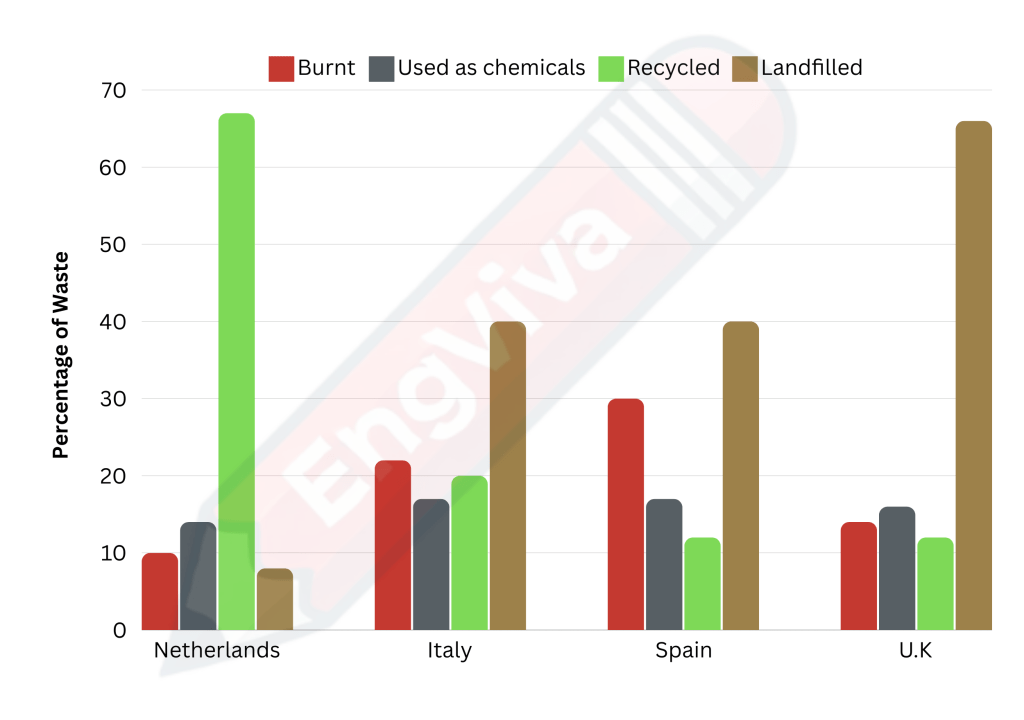
Task 1: The graph below shows four methods of dealing with waste in four countries. Summarise the information by selecting and reporting the main features and make comparisons where relevant.
Band 6.0-6.5:
The bar chart illustrates four different methods of waste disposal used in the Netherlands, Italy, Spain, and the UK. These methods include burning waste, using it as chemicals, recycling, and landfilling.
Overall, the most notable difference is that recycling is the dominant method in the Netherlands, while landfilling is the most common in the UK. In comparison, Italy and Spain show a more balanced distribution of waste management techniques.
In the Netherlands, about 65% of waste is recycled, while landfilling is almost nonexistent. In contrast, the UK disposes of 60% of waste in landfills, with a small proportion recycled. Italy and Spain rely on a variety of methods, with about 35% of waste in Italy sent to landfills, while Spain burns around 25% of its waste. Both countries also use chemicals for about 15-20% of their waste disposal.
In conclusion, the chart shows that waste management strategies differ significantly between these four countries, with each nation adopting its own combination of methods.
Band 7.0-7.5:
The bar chart compares the use of four waste disposal methods in the Netherlands, Italy, Spain, and the UK. The methods are burning, using waste as chemicals, recycling, and landfilling.
It is evident that the Netherlands and the UK have starkly different approaches, with recycling being the most prominent method in the Netherlands, while the UK prefers landfilling. In the Netherlands, approximately 65% of waste is recycled, and the amount sent to landfills is negligible. On the other hand, the UK disposes of about 60% of its waste in landfills, with recycling playing a much smaller role.
Italy and Spain adopt a more balanced approach, though both countries still favor landfilling. In Italy, 35% of waste is landfilled, and around 20% is recycled. Spain burns 25% of its waste, and around 30% is sent to landfills, with smaller amounts used as chemicals or recycled.
To summarize, each country adopts a distinct approach to waste management, with the Netherlands leading in recycling and the UK relying heavily on landfilling.
Band 8.0-8.5:
The bar chart presents data on four different methods of waste disposal—burning, using as chemicals, recycling, and landfilling—across four countries: the Netherlands, Italy, Spain, and the UK. These methods show considerable variation in usage patterns among the countries.
Recycling dominates the Netherlands’ approach, with approximately 65% of waste being recycled. In contrast, landfilling is almost negligible in this country. On the other hand, the UK shows a stark reliance on landfilling, with around 60% of waste being disposed of in this way, while only a small percentage is recycled.
Italy and Spain follow more varied waste management strategies. Italy landfills 35% of its waste and recycles about 20%, while also burning waste and using it as chemicals in smaller quantities. Spain adopts a similar pattern, with around 30% of waste going to landfills and 25% being burnt. Both countries use chemicals for 15-20% of their waste.
In summary, the chart reveals that the Netherlands excels in recycling, while the UK heavily relies on landfilling. Italy and Spain show a more mixed approach to waste disposal, using various methods to manage their waste.
Here’s a breakdown of the differences between the three IELTS Task 1 responses at bands 6.0-6.5, 7.0-7.5, and 8.0-8.5, focusing on key aspects such as vocabulary, structure, complexity, and accuracy:
1. Vocabulary
- Band 6.0-6.5:
- Vocabulary is basic and functional. Words like burning, using as chemicals, recycling, and landfilling are straightforward and repeated.
- Phrases like “most notable difference” and “balanced distribution” show some ability to describe differences but lack variety.
- The vocabulary is appropriate but lacks sophistication and variety.
- Band 7.0-7.5:
- Vocabulary is more varied, with terms like prominent method, reliance, and balanced approach replacing simpler words.
- There’s more paraphrasing, e.g., “landfilling is the most common” vs. “disposes of 60% of waste in landfills.”
- Some descriptive phrases like “balanced approach” and “starkly different approaches” demonstrate a stronger grasp of nuanced language.
- Band 8.0-8.5:
- Vocabulary is sophisticated and more precise. Words like dominates, negligible, stark reliance, and varied strategies show a high degree of control.
- There’s more use of less common lexical items, like “considers” and “excels.”
- Synonyms are well-chosen to avoid repetition, adding variety and precision to the writing.
2. Sentence Structure and Complexity
- Band 6.0-6.5:
- Sentence structure is mostly simple and compound. For example, “In the Netherlands, about 65% of waste is recycled, while landfilling is almost nonexistent.”
- There are fewer complex sentences and little variety in sentence beginnings or transitions. Connectors like while and in contrast are used, but there’s less sophistication in linking ideas.
- Band 7.0-7.5:
- Sentence structure is more complex. There’s greater use of subordinating conjunctions, e.g., “It is evident that…” or “with recycling being the most prominent method.”
- There are more varied sentence beginnings, such as “It is evident that…” or “Italy and Spain adopt a more balanced approach, though both countries…”
- The transitions between ideas are clearer and smoother, using more advanced connectors like though and on the other hand.
- Band 8.0-8.5:
- The structure is highly complex, with well-developed compound and complex sentences. For example, “The bar chart presents data on four different methods of waste disposal—burning, using as chemicals, recycling, and landfilling—across four countries.”
- The sentences flow naturally, using sophisticated linking devices and modifiers, e.g., “show considerable variation in usage patterns.”
- Sentences are diverse in structure, with a mixture of simple, compound, and complex forms.
3. Grammatical Range and Accuracy
- Band 6.0-6.5:
- Grammar is generally accurate but basic. There is little use of advanced grammatical structures.
- Some errors might still occur in more complex sentences, but the meaning is clear. For example, “The chart shows that… each country adopting its own combination…” (simplified relative clause usage).
- Band 7.0-7.5:
- Grammar is generally accurate, with a few more complex structures. There’s better use of passive voice and relative clauses, e.g., “Italy and Spain adopt a more balanced approach, though both countries still favor landfilling.”
- Errors are less frequent and less impactful on meaning. Clauses and relative clauses are correctly used to express ideas with more complexity.
- Band 8.0-8.5:
- The grammar is highly accurate, with a wide range of structures used. There’s frequent and accurate use of passive voice, relative clauses, and more complex forms, e.g., “Recycling dominates the Netherlands’ approach, with approximately 65% of waste being recycled.”
- There are no noticeable errors, and sentence structures are sophisticated and flexible.
4. Clarity and Development of Ideas
- Band 6.0-6.5:
- Ideas are presented clearly, but some lack depth or precise explanation. For instance, “the most notable difference is that recycling is the dominant method in the Netherlands.”
- The writing is clear but lacks elaboration and thorough comparisons.
- Band 7.0-7.5:
- The ideas are clearly expressed, with better development and more comparisons. For example, “Italy and Spain adopt a more balanced approach, though both countries still favor landfilling.”
- There’s more focus on comparing the methods in different countries, showing better insight into the data.
- Band 8.0-8.5:
- Ideas are thoroughly developed, with detailed comparisons and clear insights into the data. For example, “The Netherlands excels in recycling, while the UK heavily relies on landfilling.”
- The ideas are fully explored, with sophisticated transitions between points, making the argument more coherent and compelling.
5. Use of Data and Figures
- Band 6.0-6.5:
- Data is used accurately but in a straightforward way. For instance, “In the Netherlands, about 65% of waste is recycled.”
- The data is described rather than analyzed in detail.
- Band 7.0-7.5:
- Data is used to support points more effectively. For example, “Recycling accounts for approximately 65% of waste in the Netherlands.”
- There is more emphasis on making comparisons between the countries, with more subtle analysis.
- Band 8.0-8.5:
- Data is integrated seamlessly into the analysis. For example, “Recycling dominates the Netherlands’ approach, with approximately 65% of waste being recycled.”
- The figures are used as part of a sophisticated narrative, with insightful comparisons and contrasts.
Summary of Differences:
- Band 6.0-6.5: Basic vocabulary, simple sentence structures, and straightforward use of data. The ideas are clear but not deeply developed or compared.
- Band 7.0-7.5: More variety in vocabulary and sentence structure. Ideas are more developed, with clearer comparisons between the countries, and there’s some use of advanced grammar.
- Band 8.0-8.5: Highly developed ideas, sophisticated vocabulary, and complex sentence structures. The data is analyzed in depth, with insightful comparisons, and grammar is nearly flawless.
Discover more from Viva English Academy
Subscribe to get the latest posts sent to your email.
 Viva English Academy